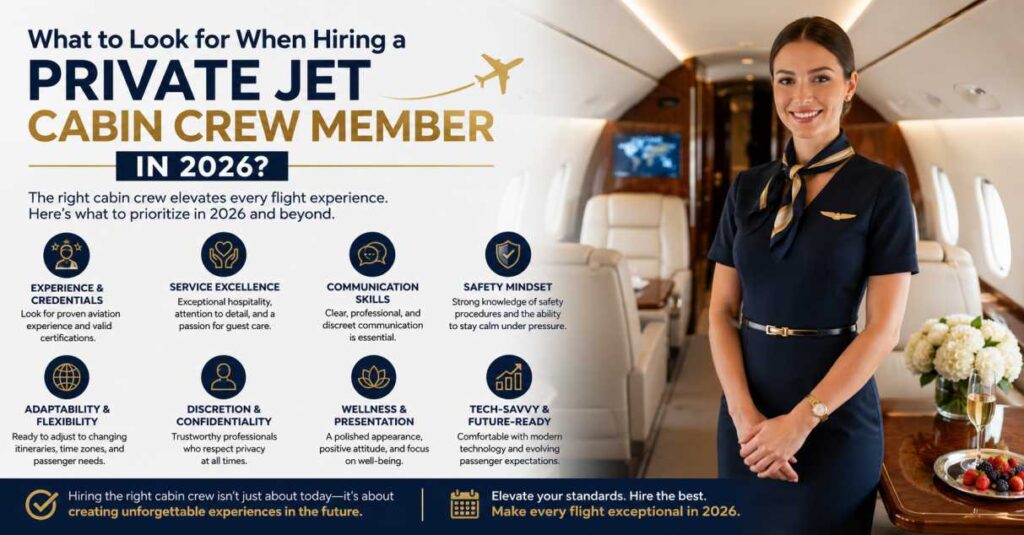
What to Look for When Hiring a Private Jet Cabin Crew Member in 2026
Private jet cabin crew are the face of your operation. Hiring the right person in 2026 means balancing safety, service, discretion, and long‑term fit.
Use these criteria to screen candidates quickly and consistently.
1. Why Hiring Standards Matter in 2026
Passenger expectations and regulatory scrutiny are higher than ever. A weak cabin‑crew hire can damage safety, compliance, and your brand.
Clear hiring standards reduce risk and ensure every crew member supports both operations and owner experience.
2. Safety and Emergency Competency
Safety is non‑negotiable.
Key checks:
- Completion of recognized cabin‑safety and emergency training (evacuation, fire, medical, CRM).
- Clear knowledge of aircraft exits, safety equipment locations, and communication with the flight deck.
- Evidence of recent recurrent drills or training, not just past airline experience.
If they cannot confidently describe how to handle a blocked exit or in‑flight fire, they are not ready.
3. Service Experience and Professionalism
Private‑jet passengers expect five‑star service, not standard airline service.
Look for:
- Background in upscale hospitality (luxury hotels, yachts, fine dining, VIP lounges).
- Ability to manage temperature, lighting, galley workflow, and noise without close supervision.
- Strong personal grooming, punctuality, and comfort working with high‑net‑worth or high‑profile passengers.
Many operators prefer 2–3 years of corporate or high‑service background, even with airline experience.
4. Compliance, Documentation, and Security
Modern business aviation demands strict compliance and security awareness.
Check:
- Valid medical certificate and fitness‑to‑fly status.
- Up‑to‑date first‑aid, CPR, and basic medical training.
- Understanding of security protocols, passenger‑behavior observation, and incident‑reporting.
- Clean background checks and willingness to follow drug‑and‑alcohol policies.
If their documentation is messy or their rules‑awareness is weak, they are not a safe fit.
5. Cultural Fit and Discretion
Trust and discretion are as important as technical skills.
Red flags and green flags:
- Must maintain absolute confidentiality about itineraries, passengers, and conversations.
- Comfortable in small‑team environments with frequent changes in schedule and crew.
- Emotionally mature, adaptable, and professional under pressure and during long‑haul or multi‑stop trips.
Ask behavioral questions (“Describe a time you dealt with a difficult passenger”) to test their composure.
6. Aircraft‑Type and Mission Fit
Not every crew member can step into a Gulfstream‑style cabin and operate smoothly.
Assess:
- Experience on aircraft similar in size and layout to your fleet (large‑cabin, mid‑size, or light jets).
- Comfort with long‑haul, multi‑stop, and international trips, including customs and immigration.
- Willingness to learn owner‑specific rules (pets, working‑travel, pets, in‑flight meetings, special equipment).
If they have only worked on short‑haul regional jets or mass‑airline cabins, expect a longer on‑ramp.
7. Communication and CRM Skills
Crew‑resource‑management (CRM) is critical in the cabin as well as the cockpit.
Look for:
- Clear, calm, and professional communication style.
- Strong English language skills; a second language (French, Spanish, Arabic, Mandarin) is a strong plus.
- Ability to raise safety or operational concerns respectfully and constructively.
Avoid candidates who appear passive, overly quiet, or reluctant to speak up during critical phases.
8. Long‑Term Fit and Career Attitude
In 2026, turnover is a real issue. You want a cabin crew who will stay and grow with the operation.
Consider:
- Green flags: interest in long‑term private‑aviation careers, openness to training, and pride in previous roles.
- Warning signs: frequent job changes, lack of clear examples, or treating the role as “just a temporary step.”
Ask them directly about their 3–5 year career plan and how private aviation fits into it.
FAQs
At least 2–3 years of corporate or high‑end hospitality experience, plus solid safety training and a clean record.
It helps, but many operators want additional private‑style or VIP‑service background.
Yes: first‑aid/CPR, safety training, valid medical, and ideally recurrent CRM and aircraft‑specific training.
Behavioral questions, safety‑scenario questions, and a practical check of how they would prepare a cabin or galley.
Only if you are prepared to fully train them in aircraft‑specific safety and procedures; many operators prefer a hybrid background
Social media, data‑privacy rules, and high‑profile clients make confidentiality a core requirement, not optional.