Cabin Crew Safety Regulations for Private Jets in Europe vs. the US: A 2026 Comparison
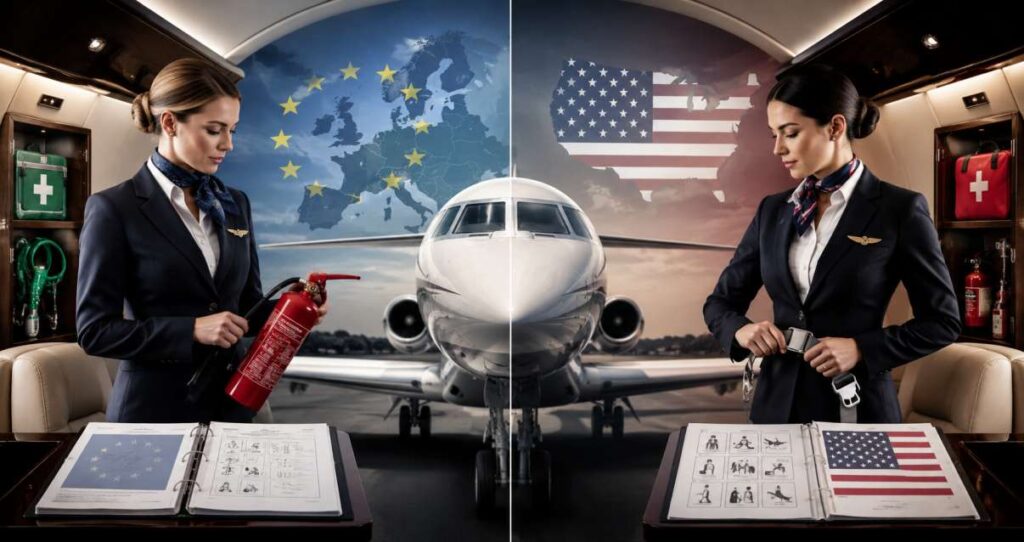
In 2026, cabin crew safety regulations for private jets differ noticeably between Europe and the United States. The US follows primarily FAA rules, while Europe follows EASA rules, with stricter expectations for cabin safety, documentation, and ramp inspections.
For operators flying in both regions, understanding these differences is key to staying compliant and avoiding delays. This guide compares the two systems, using the same short‑bullet‑point style you have been using.
1. Regulatory Framework and Authority
The main difference lies in the regulatory bodies and their approach.
United States (FAA)
- Authority: Federal Aviation Administration (FAA).
- Framework: 14 CFR Part 91 (private) and Part 135 (charter).
- Many private flights fall under Part 91, which has fewer explicit cabin‑crew rules.
- Rules are often operator‑driven and flexible.
Europe (EASA)
- Authority: European Union Aviation Safety Agency (EASA).
- Framework: EU Regulation 965/2012 (CAT) plus national rules.
- EASA applies more uniform, commercial‑style rules even to many business‑aviation operations.
- Expectations are more explicit and codified.
2. Cabin Crew Requirements: Mandatory vs Flexible
Europe generally imposes stricter cabin crew requirements than the US.
United States (FAA)
- Formal cabin crew are often not required for small jets under Part 91.
- Safety training is operator‑driven, often treated as best practice.
- Recurrent training is common but not always strictly codified.
- Roles can be service‑focused or hybrid.
Europe (EASA)
- Formal cabin crew are more likely required for larger or charter operations.
- Explicit expectations for safety and emergency training.
- Recurrent training is often required and must be documented.
- Roles are more likely to be safe‑qualified where applicable.
In practice, many US operators still train cabin crew to strong standards, but the regulatory baseline is less prescriptive.
3. Emergency and Evacuation Training
Both regions expect safe operations, but Europe is more explicit.
United States (FAA)
- Emphasis on best practice and insurance requirements.
- Operators often require evacuation, fire, and first‑aid training.
- Rules vary by operating certificate (Part 91 vs Part 135).
Europe (EASA)
- Clearer expectations for emergency procedures and evacuation training.
- Crew must know exits, doors, slides, and emergency equipment.
- Ramp inspections can check cabin safety items directly.
4. Ramp Inspections and Documentation
Europe conducts more frequent and detailed ramp inspections.
United States (FAA)
- Occasional FAA ramp checks.
- Focus on general safety and compliance.
- Consequences may include warnings and corrective actions.
Europe (EASA)
- Frequent SAFA (Safety Assessment of Foreign Aircraft) inspections.
- Detailed checklist, including cabin safety items.
- Can delay or ground aircraft until issues are fixed.
Common SAFA discrepancies include:
- Missing or poor‑condition cabin safety equipment.
- Incomplete documentation or charts.
- Non‑compliant equipment codes or TCAS versions.
5. Medical and Licensing Expectations
Crew licensing and medical standards differ slightly.
United States (FAA)
- Pilots must hold FAA medicals; cabin crew medical rules are less strict.
- Second‑class FAA medical may meet ICAO minimums but can be questioned in Europe.
Europe (EASA)
- European inspectors prefer a valid FAA first‑class medical for US crews.
- Medical certificates older than six months, especially for pilots over 40, may be rejected.
- Type ratings must be clearly stated on the certificate.
For cabin crew, operators often align with the stricter standard to avoid issues on both sides.
6. Noise, APU, and Environmental Rules
Environmental rules affect cabin operations indirectly.
United States
- Noise abatement is often advisory.
- APU use is more discretionary, based on fuel planning.
Europe
- Noise abatement (NADP 1 or NADP 2) is mandatory at many airports.APU use is strictly limited at airports like Nice and Le Bourget.
- Fines can be issued for overuse; ground power must be prearranged.
Cabin crew must be aware of ground procedures that affect announcements, galley power, and timing.
7. Passenger Rights and Consumer Protection
Europe has stronger passenger‑rights regulations.
United States
- Fewer statutory passenger‑rights rules for private jets.
- Service expectations are mostly contractual and brand‑driven.
Europe
- EU261 reforms remain a priority in 2026, with stronger consumer protections.
- Operators may face more scrutiny on delays, cancellations, and service issues.
- Cabin crew may be asked to handle passenger complaints or documentation more formally.
8. Impact on Cabin Crew SOPs and Training
Operators must adapt SOPs to both regimes.
Flight departments should:
- Use EASA‑aligned SOPs as the baseline when operating globally.
- Ensure cabin crew training meets or exceeds the stricter FAA or EASA.
- Document training clearly for SAFA and audit purposes.
- Train crew on both US and European expectations for documentation and safety.
This avoids having two separate training systems.
9. Why Staffing Partners Help with Cross‑Border Compliance
Operators flying between the US and Europe benefit from cross‑border‑ready crew.
Flight Crew International (FCI) helps operators by:
- Providing cabin crew trained to both FAA and EASA‑aligned standards.
- Offering crew familiar with SAFA readiness and documentation.
- Matching crew to operators with transatlantic or multi‑region operations.
- Reducing the risk of non‑compliance during inspections.
10. How CrewLocator Supports Cross‑Region Crew Planning
Technology helps operators manage compliance across regions.
CrewLocator helps operators by:
- Tracking crew qualifications, medicals, and training status.
- Identifying crew comfortable with both US and European operations.
- Reducing time spent verifying compliance for transatlantic trips.
- Supporting consistent standards across different regulatory environments.
Key Takeaway for Operators
Europe generally has stricter, more explicit cabin crew safety regulations and more frequent inspections than the US. In the US, many rules are operator‑driven and flexible; in Europe, they are more codified and enforced through SAFA inspections.
For operators flying in both regions, the safest approach is to design SOPs and training that meet the stricter EASA standard, while ensuring FAA compliance for US operations.
FAQs
Not always, but EASA is more likely to require safety‑qualified cabin crew for larger or charter operations than the FAA.
If they fly into Europe, yes. SAFA inspections can check cabin safety items, so alignment is practical.
A European ramp inspection of foreign aircraft that can delay or ground flights if issues are found.
Europe prefers a current FAA first‑class medical for US crews; second‑class may be questioned.
Yes. Noise abatement is mandatory, and APU use is strictly limited at many airports.
It helps track crew qualifications and training status for both FAA and EASA‑aligned operations.
Flight Crew International provides crew trained to both FAA and EASA‑aligned standards. Contact can be made at https://www.fci.aero/contact.