ACJ and BBJ Cabin Crew Staffing: Special Requirements for Wide‑Body Business Jets
ACJ and BBJ platforms are wide‑body business jets that blend airliner scale with private‑jet expectations. This means cabin crew staffing must balance commercial‑like safety scale with business‑aviation service and discretion.
For operators, understanding the special requirements of ACJ and BBJ cabin crew is key to staffing, training, and running these aircraft professionally. This guide uses the same short‑bullet‑point style you have been using.
1. Understand the Aircraft Scale
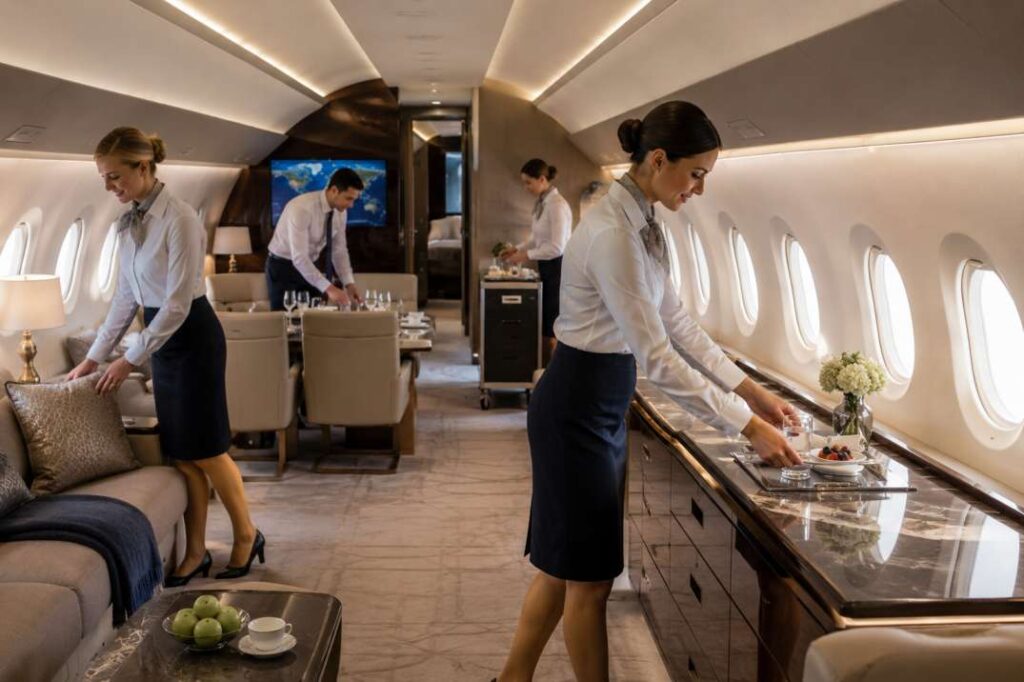
ACJs and BBJs are much larger than typical business jets.
Flight departments should:
- Recognize multiple cabin zones, large galleys, and complex amenities.
- Plan for higher passenger counts per trip even on VIP missions.
- Use more crew per passenger than on midsize business jets.
- Treat the cabin like a scaled‑up business‑aviation environment.
Scale drives both safety and service design.
2. Safety, Evacuation, and Emergency Standards
Wide‑body cabins require robust safety planning.
Flight departments should:
- Train crew for large‑cabin evacuation and multi‑exit operations.
- Require formal cabin‑safety and emergency‑procedure training.
- Confirm first‑aid and CPR certification and use of onboard medical kits.
- Run drills specific to the ACJ/BBJ layout.
Standards are closer to commercial‑aviation than small‑jet levels.
3. Crew Ratios and Relief Planning
Crewing must match the size and mission length.
Flight departments should:
- Use at least two cabin crew on most missions, even with low passenger loads.
- Add more crew for long‑range, high‑occupancy, or multi‑sector trips.
- Plan relief or hotel‑night crew on ultra‑long‑haul or back‑to‑back legs.
- Define minimum crew‑to‑passenger ratios for the fleet.
Under‑staffing increases fatigue and safety risk.
4. Service, Hospitality, and VIP Expectations
Wide‑body cabins attract large, high‑end groups.
Flight departments should:
- Expect strong hospitality and multi‑course service skills from all crew.
- Plan for complex catering, wines, and special‑diet handling.
- Emphasize discretion, confidentiality, and low‑profile service.
- Align cabin‑crew style with the operator’s corporate or VIP brand.
Clients expect the service level to match the aircraft’s size and cost.
5. Aircraft‑Specific Familiarization
Generic training is not enough for ACJ/BBJ platforms.
Flight departments should:
- Ensure crew know the layout, multiple galleys, and amenity locations.
- Confirm understanding of emergency exits, oxygen systems, and safety equipment.
- Include briefings and drills in the actual aircraft or a simulator when possible.
- Verify communication protocols with the ACJ/BBJ flight‑deck team.
Familiarity reduces confusion during normal and emergency events.
6. Duty‑Time, Fatigue, and Workload
Large‑cabin operations can overload crew if not managed.
Flight departments should:
- Define clear duty‑time limits and rest‑break expectations.
- Plan for crew rest areas or repositioning on long sectors.
- Monitor workload from service, cleaning, security checks, and client management.
- Encourage crew to report fatigue or workload concerns.
Fatigue management is as important as for pilots.
7. Regulatory and Insurance Alignment
Wide‑body business jets sit in a regulatory grey area for cabin crew.
Flight departments should:
- Clarify whether cabin crew are safety‑qualified or service‑only on the platform.
- Confirm training and recurrent checks meet operator, regulatory, and insurance rules.
- Document all training and recurrent records in a central system.
- Treat ACJ/BBJ cabin crew as safety‑integrated where appropriate.
This protects the operator in audits and after‑incident reviews.
8. SOPs, Briefings, and Flight‑Deck Integration
ACJ and BBJs must operate as a single team.
Flight departments should:
- Develop one SOP for the aircraft that includes both flight‑deck and cabin crew.
- Require joint briefings for long‑range, international, or complex missions.
- Standardize communication, security checks, and sterile‑cockpit expectations.
- Include cabin crew in recurrent training and drills with the pilots.
Crew integration is key to a professional operation.
9. Why Working With a Staffing Partner Helps
Finding wide‑body‑ready cabin crew can be difficult.
Flight Crew International (FCI) helps business aviation operators by:
- Connecting operators to vetted crew experienced on large‑cabin, long‑range jets.
- Providing pre‑screened, recurrent‑trained cabin crew aligned to SOPs.
- Matching crew profiles to ACJ/BBJ size and operator expectations.
- Offering flexible staffing for 24/7‑on‑call or project‑based operations.
10. How CrewLocator Supports ACJ/BBJ Crew Planning
Technology improves visibility into crew availability and readiness.
CrewLocator allows operators to:
- Find cabin crew with experience on large‑cabin, long‑range business jets.
- Filter by recurrent‑training status, medicals, and location.
- Reduce time spent searching for wide‑body‑ready crew.
- Track crew readiness for long‑haul, mission‑critical trips.
Building a Professional ACJ/BBJ Cabin Crew Team
For operators running ACJ and BBJ fleets, cabin crew staffing must match the scale of the aircraft while preserving the privacy and service level of business aviation. By combining safety‑focused training, aircraft‑specific familiarization, clear SOPs, and professional service standards, operators can run these wide‑body jets as safely and smoothly as any long‑range business jet.
When supported by staff‑vetting partners and tools like CrewLocator, operators can staff ACJ/BBJ cabins with confidence.
FAQs
At least two per mission is typical, with more added for long‑range or high‑passenger loads.
Yes. They should have large‑cabin evacuation, emergency, and first‑aid training.
Only after additional training and familiarization; the scale and complexity are much higher.
Long sectors and high‑workload can overload cabin crew if not managed.
As safety‑integrated where appropriate, aligned with SOPs, and focused on VIP service.
Tools like CrewLocator improve visibility into crew qualifications and availability.
Flight Crew International provides vetted, compliant cabin crew for large‑cabin, long‑range business jets. Contact can be made at https://www.fci.aero/contact.